 Halin
Halin Your Year-End Tax Checklist: What to Do Before December 31 (Philippines, 2026)
September 23, 2026 · 9 min read · Halin AI Team
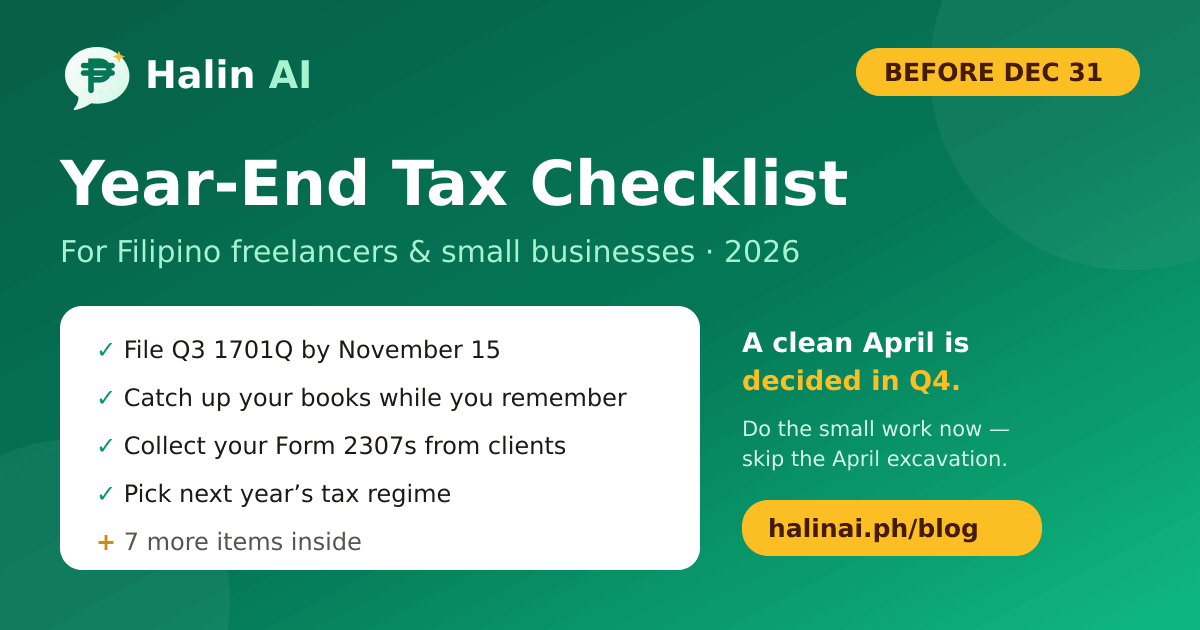
Most people meet their annual income tax return in April, in a panic, reconstructing a year they can no longer remember. The ones who don't are the ones who did a little work in the last quarter. Here's that work — eleven items, roughly in the order they come due.
1. File your Q3 returns
1701Q for Q3 is due November 15. If you're on graduated rates, 2551Q for Q3 was due October 25 — check that it went out. Both are covered step by step in our 1701Q guide and 2551Q guide, and every date sits in the 2026 calendar. File even if the quarter was ₱0.
2. Catch up your books while you can still remember
This is the highest-value item on the list, and the easiest to skip. Reconstructing October in October takes twenty minutes; reconstructing it in April takes an afternoon and produces worse numbers. Go through your bank and e-wallet history for any month you left blank and fill the gaps now, while the transactions still mean something to you.
3. Chase your Form 2307s
Every Philippine client who withheld tax from your fees owes you a Form 2307, and each one is money subtracted from your April tax bill. Clients are far more responsive about this in November and December than during their own April scramble. Make a list of who has paid you this year, tick off the 2307s you hold, and email the rest now. Freelancers who lose these effectively pay their tax twice — see proof of income.
4. Check your running gross against ₱3M
Add up your year-to-date gross sales. If you are near or past ₱3,000,000, VAT registration becomes mandatory and your whole tax setup changes — better to see that in October than to discover it retroactively. Our guide to crossing ₱3M covers what changes and how to price for it.
5. Decide next year's regime — with this year's data
The 8% option is elected on your first quarterly return of the year, which means the decision effectively gets made in a rush each Q1. You have the numbers to make it properly right now: compare your actual gross against your actual expenses and see whether 8%, graduated with OSD, or graduated with itemized deductions would have served you better this year. Start with the 8% vs graduated comparison and the OSD guide.
6. Count your inventory on December 31
If you sell goods, your closing stock matters to your cost of sales and therefore your taxable income. Count it at year-end and write the figures down — with dates. This is the one item that genuinely cannot be reconstructed later.
7. Write up your books of accounts
Your registered books of accounts should reflect the year. If you've been keeping records digitally and transferring them periodically, catch the journal and ledger up to date. If you're on loose-leaf, note the annual submission requirement that applies to your setup and confirm the current deadline with your RDO.
8. Review your invoicing
Check that what you've been issuing all year is actually correct — since the rules changed, the invoice is the primary document for both goods and services, and Official Receipts no longer serve that role. If you've been issuing the wrong document, better to fix it now than to have a year's worth of it. See invoice vs official receipt.
9. Update your registration if anything changed
Moved address, changed your line of business, added or dropped an activity? Those are BIR Form 1905 updates, and carrying stale registration details into a new year creates mismatches later — including mail you never receive about assessments.
10. If the business is dormant, close it properly
Do not carry a dead registration into another year. An unclosed business keeps generating filing obligations and penalties indefinitely, whether or not you earn a peso — this is exactly how people end up with dozens of open cases. Cancelling registration is the only thing that stops the clock.
11. Set the money aside
Your annual income tax return is due April 15, and for most self-employed people it's the single largest tax payment of the year. Estimate it now from your actual figures and move that amount somewhere you won't spend it. A known bill in December is a plan; the same bill discovered in April is a crisis.
One myth worth killing
You may remember a ₱500 annual registration fee due every January 31 on Form 0605. It was abolished by the Ease of Paying Taxes Act (RA 11976), effective January 2024 — business taxpayers no longer pay it. Form 0605 still exists for other payments such as penalties, and your Certificate of Registration must still be displayed at your place of business. Plenty of older articles and well-meaning advice still say otherwise.
The version of this list that takes ten minutes
Look again at what items 2 through 5 have in common: they're all just "know your numbers." If your books are current, year-end is a review rather than an excavation. That's the whole idea behind Halin AI — chat each sale and expense as it happens, snap the receipts, and your ledger, quarter totals, tax estimates and pre-filled worksheets are simply there when you need them, with reminders before every deadline. 100% free during early access — start here.
Disclaimer: General information only, not tax or legal advice. Deadlines, forms, and requirements change and vary by registration type and RDO — verify at bir.gov.ph or with your RDO, and have a CPA review your annual filing.
Gusto mo ng bookkeeper na kasing-dali ng chat?
I-chat mo lang ang benta mo — Bisaya, Tagalog, o English — at si Halin na ang bahala sa libro, tax computation, at BIR reminders. Libre habang early access!
Simulan — libre 🚀Basahin din:
- Haven't Been Filing? Understanding BIR Open Cases and How People Catch Up (2026)
- Crossing ₱3 Million: What Happens When Your Business Outgrows Non-VAT Status (2026)
- What Business Expenses Can You Actually Deduct? A Philippine Freelancer Guide (2026)
- Invoice vs Official Receipt: What Filipino Freelancers and Small Businesses Must Issue Now (2026)
- No Payslip? How Freelancers and Small Business Owners Can Prove Income in the Philippines
- OSD: The 40% Tax Deduction Most Filipino Freelancers Have Never Heard Of (2026)
- BIR Books of Accounts Explained: What They Are, Which Ones You Need, and How to Keep Them (2026)
- Is Your Business Actually Making Money? How to Know (Without an Accountant)
- How to File BIR Form 1701Q: Step-by-Step Guide for Freelancers & Sole Proprietors (2026)
- Freelance Tax in the Philippines (2026): How Much Do You Actually Pay?
- Paano Mag-simula ng TikTok Shop sa Pilipinas (2026): Setup, Requirements, at Buwis ng Online Sellers
- BIR Tax Deadlines 2026: Kumpletong Calendar para sa Freelancers at Small Business Owners
- Bookkeeping for Freelancers and Small Businesses in the Philippines: The Simple 2026 Guide
- Paano Mag-file ng BIR Form 2551Q: Step-by-Step Guide para sa Freelancers at Small Business (2026)
- 8% Flat Tax vs Graduated Rates: Alin ang Mas Sulit para sa Freelancers? (2026)
- Paano Mag-register sa BIR bilang Freelancer o Online Seller: Complete Guide (2026)