 Halin
Bisaya Business Words in English: 30 Terms Every Negosyante Should Know
November 1, 2026 · 6 min read · Halin AI Team
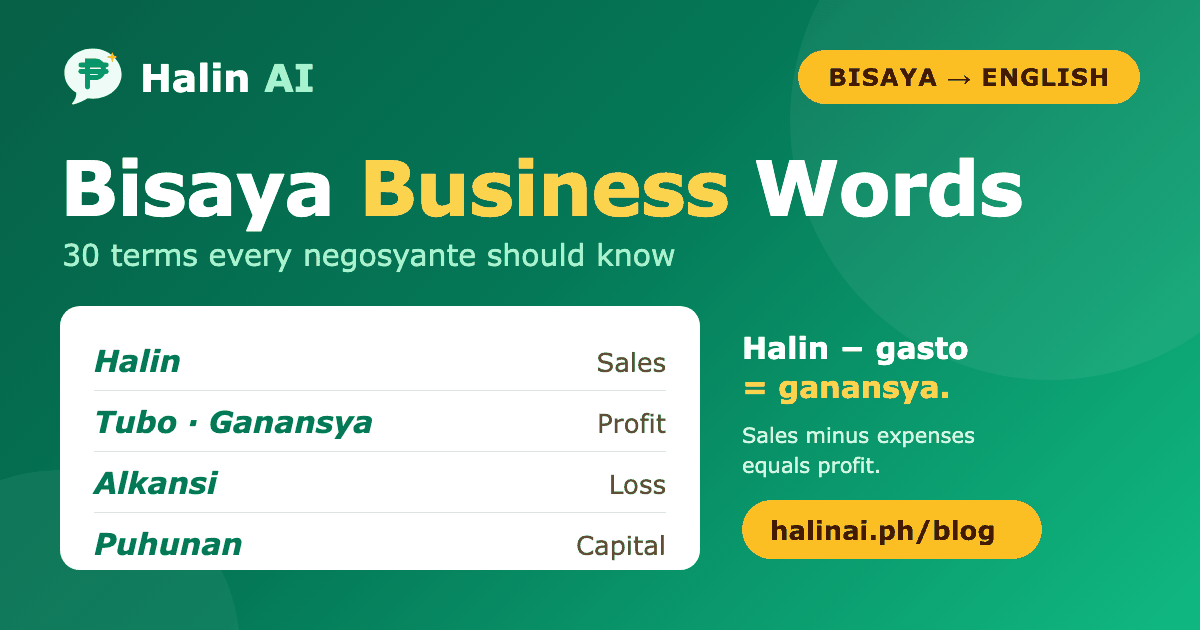
If you run a business in Cebu, Davao, Cagayan de Oro, or anywhere in the Visayas and Mindanao, you probably talk about money in Bisaya — but forms, banks, and the BIR speak English. This glossary bridges the two: 30 everyday Bisaya (Cebuano) business words, what they mean in English, and the Tagalog equivalent.
Money coming in
- Halin — sales (Tagalog: benta). The total money from selling, before expenses. "Pila imong halin karon?" — How much were your sales today? Full explainer: halin meaning in English.
- Baligya — goods for sale; to sell (Tagalog: paninda; magbenta). "Unsa imong baligya?" — What are you selling?
- Tigbaligya — seller, vendor (Tagalog: tindero/tindera).
- Suki — regular customer (same in Tagalog).
- Bayad — payment (same in Tagalog).
- Presyo — price (same in Tagalog).
- Barato — cheap (Tagalog: mura). Mahal — expensive.
- Diskwento — discount.
- Sukli — change (the money you give back). "Naa kay sukli sa mil?" — Do you have change for a thousand?
Profit, loss, and capital
- Tubo — profit (also used for interest on a loan). Tagalog: tubo or kita.
- Ganansya — profit, earnings. What's left of your halin after expenses.
- Puhunan / Puhonan — capital — the money you put into the business. "Nabawi na ba ang puhunan?" — Have you recovered your capital?
- Alkansi — loss (Tagalog: lugi). "Tubo ba o alkansi?" — Profit or loss?
- Nalugi — lost money; went under — borrowed from Tagalog and common in Bisaya too.
The single most useful formula in any language: halin − gasto = ganansya (sales − expenses = profit). If the answer is negative, that's alkansi. Not sure which side you're on? Read is your business actually making money?
Money going out
- Gasto — expense, spending (Tagalog: gastos). Galastohan — expenses (as a group).
- Abang — rent (Tagalog: upa).
- Sweldo / Suholan — salary, wages (Tagalog: sahod).
- Plete — fare, transport cost (Tagalog: pamasahe).
- Kuryente — electricity. Tubig — water.
- Buhis — tax (Tagalog: buwis). The BIR collects buhis on your halin and ganansya — see how much tax freelancers actually pay.
Many of these are deductible if they're for the business — see which expenses you can deduct.
Credit and debt
- Utang — debt; buying on credit (same in Tagalog). "Utang sa ko, bayran nako ugma." — Let me buy on credit, I'll pay tomorrow.
- Pautang — lending; a loan you give.
- Nangutang — borrowed (money).
- Hulam — borrow (usually an item, sometimes money).
- Bayranan — amount payable; bill.
- Lista — list — especially the store's list of who owes what.
Records and timing
- Resibo — receipt. (For BIR purposes, registered businesses now issue invoices.)
- Kwenta — computation; the count. "Kwentaha daw" — Please compute it.
- Inadlaw — daily. Sinemana — weekly. Binulan — monthly (also a monthly installment).
A note on Ilonggo (Hiligaynon)
Bisaya isn't one language. In Hiligaynon (Ilonggo), halin usually means "from" — as in "Halin ako sa Iloilo" (I'm from Iloilo) — not sales. Words also differ across Waray, Boholano, and other Visayan languages, so if a word sounds off to you, it's probably a regional difference.
Record your business in your own language
Most bookkeeping apps make you translate your day into accounting English. Halin AI doesn't: just chat the way you'd talk — "Nakahalin ko ug 3,500 karon, GCash" or "Gasto 450 plete ug pagkaon" — and it's recorded as sales or expenses, with your utang list, profit, and estimated taxes kept up to date. It works in Bisaya, Tagalog, and English. 100% free during early access — start here.
Common questions
What is "profit" in Bisaya?
Tubo or ganansya. Both mean the money left after expenses. Halin is sales, not profit.
What is "loss" in Bisaya?
Alkansi. You'll also hear nalugi, borrowed from Tagalog.
What is "capital" in Bisaya?
Puhunan (also spelled puhonan) — the money you invest to start or run the business.
What does "baligya" mean?
Goods for sale, or the act of selling. "Halin sa baligya" means the sales from your goods.
Is Bisaya the same as Cebuano?
In everyday use, "Bisaya" usually means Cebuano, the most widely spoken Visayan language. Strictly, Bisaya covers a family of languages, including Hiligaynon and Waray.
Gusto mo ng bookkeeper na kasing-dali ng chat?
I-chat mo lang ang benta mo — Bisaya, Tagalog, o English — at si Halin na ang bahala sa libro, tax computation, at BIR reminders. Libre habang early access!
Simulan — libre 🚀Basahin din:
- How to Pay BIR Taxes Online (2026): GCash, Maya, LandBank & More
- BIR Form 2307 Explained: The Tax You Already Paid (and How to Claim It)
- Halin Meaning in English: The Bisaya Word for Sales (Not Profit)
- Your Year-End Tax Checklist: What to Do Before December 31 (Philippines, 2026)
- Haven't Been Filing? Understanding BIR Open Cases and How People Catch Up (2026)
- Crossing ₱3 Million: What Happens When Your Business Outgrows Non-VAT Status (2026)
- What Business Expenses Can You Actually Deduct? A Philippine Freelancer Guide (2026)
- Invoice vs Official Receipt: What Filipino Freelancers and Small Businesses Must Issue Now (2026)
- No Payslip? How Freelancers and Small Business Owners Can Prove Income in the Philippines
- OSD: The 40% Tax Deduction Most Filipino Freelancers Have Never Heard Of (2026)
- BIR Books of Accounts (2026): Samples, Types & How to Keep Them
- Is Your Business Actually Making Money? How to Know (Without an Accountant)
- How to File BIR Form 1701Q for Q3 2026 (Due Nov 15): Step-by-Step Guide
- Freelance Tax in the Philippines (2026): How Much Do You Actually Pay?
- Paano Mag-simula ng TikTok Shop sa Pilipinas (2026): Setup, Requirements, at Buwis ng Online Sellers
- BIR Tax Deadlines 2026: Kumpletong Calendar para sa Freelancers at Small Business Owners
- Bookkeeping for Freelancers and Small Businesses in the Philippines: The Simple 2026 Guide
- Paano Mag-file ng BIR Form 2551Q: Step-by-Step Guide para sa Freelancers at Small Business (2026)
- 8% Flat Tax vs Graduated Rates: Alin ang Mas Sulit para sa Freelancers? (2026)
- Paano Mag-register sa BIR bilang Freelancer o Online Seller: Complete Guide (2026)